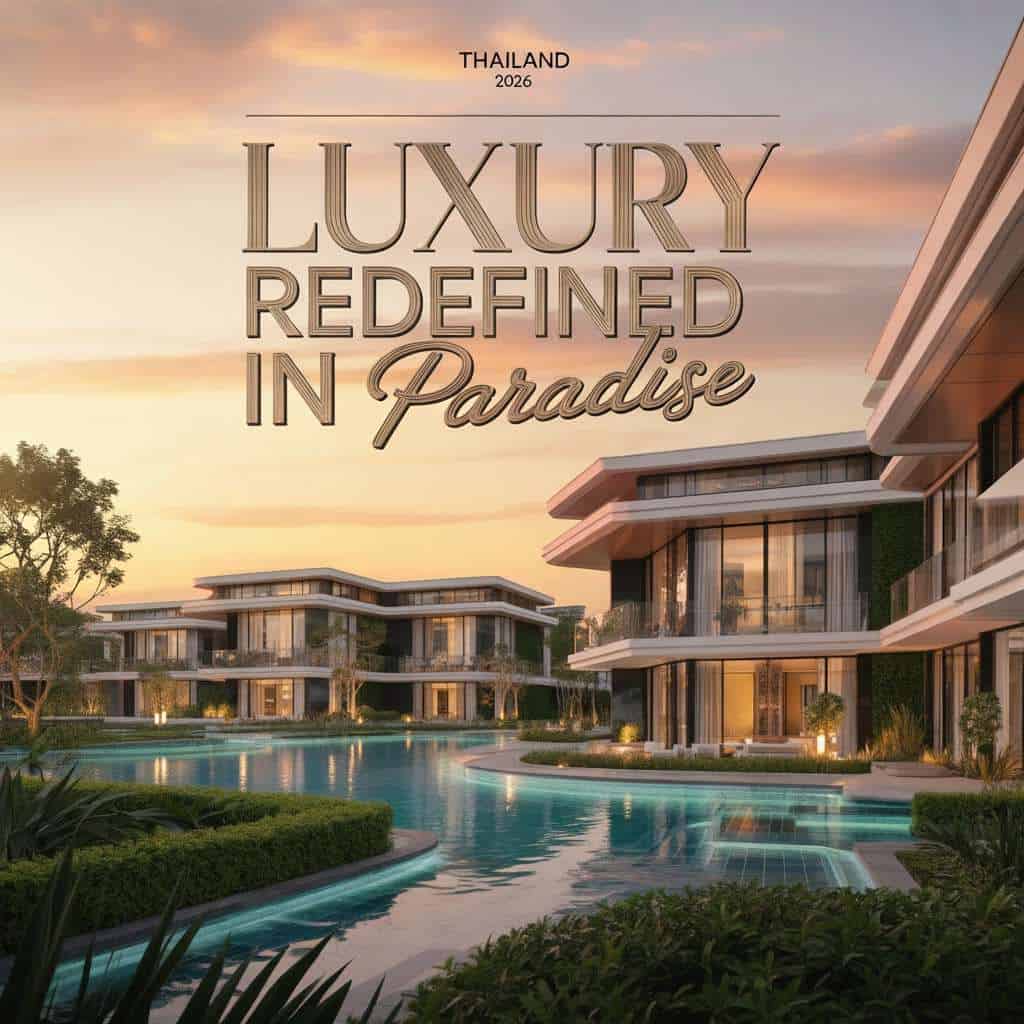
The Rise of the ‘Branded Residence’ in Thailand:
Why Global Investors are Ditching Traditional Condos in 2026
The landscape of Thailand property investment in 2026 has reached a fascinating crossroads. For decades, the “buy-to-let” model focused on standard condominiums. However, a new dominant species has emerged in the luxury sector: the Branded Residence. In 2026, these assets are significantly outperforming the mass market, particularly for foreign buyers seeking the elusive trifecta of security, professional management, and lifestyle prestige.
1. The 2026 Market Shift: Why ‘Brand’ Matters Now
Success in Thai real estate is no longer about simply “buying a condo”; it is about surgical asset selection. Branded residences—properties affiliated with a global hospitality titan like Four Seasons or The Ritz-Carlton—have become the “gold standard” for international capital. Thailand currently holds the highest number of completed branded residence projects in Asia Pacific, ranking first in the region and fourth globally, behind only the US, UAE, and Mexico.
This dominance is driven by a structural shift towards “Lifestyle Assets.” In 2026, the global “Generation of Renters” is prioritising flexibility and service over simple ownership. For the investor, this means your exit strategy must align with what the market actually wants: hotel-grade services, impeccable maintenance, and a name that carries weight in London, New York, or Hong Kong.
2. Comparative Analysis: Four Seasons vs. The Ritz-Carlton Residences
For investors choosing between the two “titans” of the Bangkok skyline, the decision often comes down to lifestyle preference versus investment structure. Below is a direct comparison of these flagship properties as of early 2026.
| Feature | Four Seasons Private Residences | The Ritz-Carlton Residences |
|---|---|---|
| Primary Location | Chao Phraya River (Riverside) | MahaNakhon (Sathorn/CBD) |
| Ownership Type | 75-Year Leasehold (Protected) | Freehold (Foreign Quota) |
| Est. Price per SQM | Approx. ฿500,000+ ($14,500+) | Approx. ฿375,000 – ฿450,000+ |
| Estimated Gross Yield | 4.5% – 6% (Short-term focus) | 4% – 5.5% (Long-term executive) |
| Standout Amenity | Four Seasons Club (3-Floor Sky Club) | The Ritz-Carlton Club (Level 54) |
| Architectural Style | Contemporary Urban Resort | Iconic “Pixelated” Skyscraper |
3. The ‘Brand Premium’: Quantifying the Advantage
On average, branded residences in Thailand achieve a 30% to 39% price premium over unbranded luxury units. This isn’t just an extra cost; it’s an insurance policy. Branded properties in prime locations appreciate at 12-18% annually, compared to 5-8% for standard alternatives. This resilience is due to “scarcity value”—there is only one Four Seasons Private Residence on the river, and once the 355 units are gone, the secondary market becomes the only entry point.
4. 2026 Property Tax Guide for Foreign Investors
Navigating the Thailand property tax system in 2026 is essential for accurate ROI modelling. While Thailand remains highly tax-efficient, several key updates have been implemented to support long-term investment stability.
Purchase & Transfer Costs
- Transfer Fee: Standard 2% of the government’s appraised value, typically split 50/50 between buyer and seller.
- Stamp Duty: 0.5% of the registered value, payable only if Specific Business Tax (SBT) is not applicable.
- Specific Business Tax (SBT): 3.3% of the sale price if the property is sold within 5 years of acquisition. This tax is waived if the owner holds the property for more than 5 years.
Annual Land and Building Tax
As of March 2026, the Minimum Retail Rate (MRR) is 7.105%, and annual taxes remain low. For most investment condominiums, the rate begins at 0.02% of the appraised value. This ensures that the carrying cost of a premium lifestyle asset remains negligible compared to major hubs like Singapore or Hong Kong.
5. Financing for Foreigners in 2026
While most Thai banks are conservative, several 2026 pathways exist for foreign financing. UOB (Singapore) and ICBC (China) remain the primary offshore mortgage providers, typically offering a Loan-to-Value (LTV) ratio of up to 70% for freehold condos. Loans are often denominated in SGD or USD, with terms spanning up to 30 years.
For those seeking local solutions, MBK Guarantee offers a “foreigner-friendly” mortgage that does not require a Thai work permit or residency. MBK typically lends up to 50% of the valuation for a term of 1 to 10 years in Thai Baht. This is an ideal solution for investors wanting to leverage an existing Thai property to fund a new branded residence purchase.
6. Synergy: The LTR Visa and Luxury Property
The 10-year Long-Term Resident (LTR) Visa has fundamentally changed the sales velocity of Branded Residences. By 2026, the “Wealthy Global Citizen” track has become the most popular route for investors from the UK, US, and Europe. This visa offers multiple-entry rights, a 10-year validity, and significant tax exemptions on foreign-sourced income brought into Thailand.
7. Inheritance Laws and Estate Planning
A critical consideration for the “Masterclass” investor is the transfer of wealth. Under the Thai Condominium Act, foreigners can inherit property, but the process is governed by specific rules. To legally register ownership, a foreign heir must qualify for ownership under Section 19 of the Act (e.g., by bringing in foreign currency for the appraised value). If the heir does not qualify, they are legally required to dispose of the unit within one year. We strongly recommend drafting a **Thai Will** to ensure your luxury asset passes smoothly to your beneficiaries without the complications of interstate succession.
8. Conclusion: Securing Your 2026 Portfolio
Branded residences provide a “safe haven” in 2026 through operational excellence and brand-backed security. By understanding the tax landscape, leveraging residency programs like the LTR visa, and selecting the right financing partner, international buyers can achieve a level of financial predictability that is rare in today’s global market.
General Disclaimer: The information provided in this post is for informational and educational purposes only and does not constitute financial, investment, legal, or tax advice. Property market conditions and tax regulations in Thailand are subject to change. Investors are encouraged to conduct their own due diligence and consult with qualified legal and financial professionals before making any real estate commitments. Kan Homes does not guarantee future returns or capital appreciation.