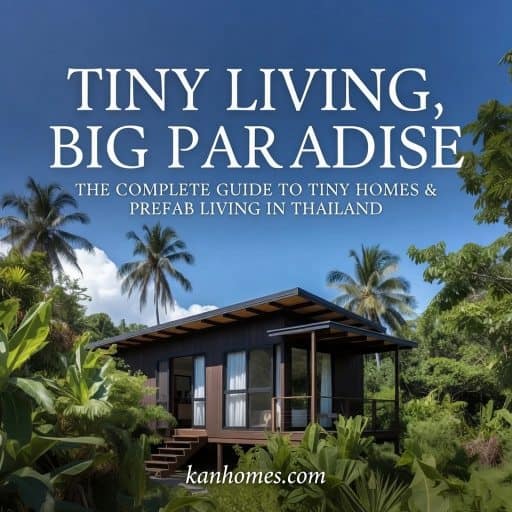
🏡 SERIES: Part 1 of 5 — Tiny Living, Big Paradise
Why Everyone’s Talking About Tiny Homes in Thailand
Picture this: you wake up to birdsong instead of traffic, step onto your own private deck with a cup of Thai coffee, and watch the mist roll over the mountains — all before your “commute” (a ten-second stroll to your outdoor desk). Sounds like a fantasy? For a growing number of digital nomads, retirees, and savvy investors, it’s simply Tuesday.
Welcome to the tiny home and prefab housing boom sweeping across Thailand. If you’ve been scrolling through Instagram dreaming of a life that’s smaller in square footage but bigger in freedom, you’re not alone — and you’ve landed in exactly the right place. This is Part 1 of our five-part series where we’ll walk you through everything from cost to legality to the best regions to plant your tiny roots.
Let’s dig into why this movement is exploding right now.
🌴 What Exactly Is a “Tiny Home” in the Thai Context?
In the West, “tiny home” often conjures images of homes on wheels. In Thailand, the concept has evolved into something a little different — and honestly, a little more livable. Most tiny homes here are:
- Fixed-foundation micro-homes, typically 20–60 square meters
- Built using prefab, modular, or shipping-container construction
- Designed with tropical climate in mind — high ceilings, cross-ventilation, wide eaves
- Often set within eco-villages, tiny home communities, or private land plots
Think less “cramped city apartment” and more “architect-designed jungle retreat.” The Thai tiny home aesthetic leans heavily into indoor-outdoor living, natural materials like teak and bamboo, and a design philosophy that treats “small” as a feature, not a compromise.
🧳 Who’s Actually Buying These Homes?
This isn’t a niche trend anymore — it’s a full lifestyle migration. Here’s who we’re seeing show up again and again:
| Buyer Type | Why Tiny Homes Appeal to Them |
|---|---|
| Digital Nomads | Low cost of living, strong Wi-Fi infrastructure, easy visa-friendly hubs like Chiang Mai |
| Retirees | Affordable healthcare nearby, warm climate, manageable single-level living |
| Investors | Strong short-term rental demand from tourists seeking “unique stays” |
| Minimalists | A genuine lifestyle reset — less stuff, less stress, more life |
💰 The Big Draw: It’s Genuinely Affordable
Let’s be honest — cost is usually the headline reason people start Googling “tiny homes Thailand” at 11pm. Compared to building or buying a traditional single-family home in Thailand (or almost anywhere back home), tiny and prefab homes can dramatically cut both build costs and ongoing expenses.
We’ll go deep into exact numbers in Part 4 of this series, but as a teaser: many buyers are getting into a fully finished, architect-designed tiny home for a fraction of what a down payment alone would cost in cities like Sydney, London, or Los Angeles.
🌱 Why the Timing Is Right Now
A few forces are converging to make this THE moment for tiny home living in Thailand:
| Trend | Impact on Tiny Home Demand |
|---|---|
| Remote work normalization | More buyers no longer tied to a home country location |
| Rising global housing costs | Thailand offers a far lower cost of entry |
| Prefab tech improvements | Faster builds, better quality, more design options than ever |
| Sustainability mindset | Smaller footprint homes align with eco-conscious buyers |
🏝️ It’s Not Just a House — It’s a Lifestyle Upgrade
Here’s what most articles won’t tell you: buying tiny in Thailand isn’t really about the home itself. It’s about what that smaller footprint buys you back — time, money, and freedom. Less home to clean means more time at the beach. Lower monthly costs mean less pressure to grind through a 9-to-5 you’ve outgrown. A simpler structure means fewer things breaking, fewer bills, fewer headaches.
It’s the classic realtor truth applied to a new category: you’re not just buying square meters, you’re buying a version of your life that feels lighter.
🔮 What’s Coming Up in This Series
This is just the beginning. Over the next four parts, we’ll get into the nitty-gritty details you’ll need before you commit:
- Part 2: Tiny Home vs. Prefab — what’s actually the difference, and which is right for you
- Part 3: The best regions in Thailand to build (Chiang Mai vs. Koh Samui vs. Phuket vs. Hua Hin vs. Pai)
- Part 4: Real budgeting — land costs, build costs, and hidden fees nobody warns you about
- Part 5: The legal essentials every foreigner needs to know before buying land or property in Thailand
💡 Pro Tip: If you’re already dreaming about your dream tiny plot, bookmark this series — Part 3 (regions) and Part 4 (budgeting) are the two posts most people come back to again and again.
Ready to Explore Further?
Whether you’re a nomad chasing your next home base, a retiree ready for a slower pace, or an investor eyeing a growing niche market, tiny homes in Thailand offer something rare: an accessible entry point into a genuinely better lifestyle. Stick with us through this series, and by Part 5 you’ll have a real, practical roadmap — not just inspiration.
👉 Have questions about tiny home or prefab opportunities in Thailand? Reach out to the team at KAN Homes — we’re happy to point you in the right direction.
Disclaimer: This article is provided for general informational and educational purposes only and does not constitute legal, financial, tax, or professional real estate advice. Property laws, ownership rules, costs, and market conditions in Thailand are subject to change and may vary by region, developer, and individual circumstances. Readers should conduct their own independent research and consult with qualified local legal, financial, and real estate professionals before making any property-related decisions. KAN Homes makes no warranties or guarantees regarding the accuracy, completeness, or timeliness of the information presented in this post.