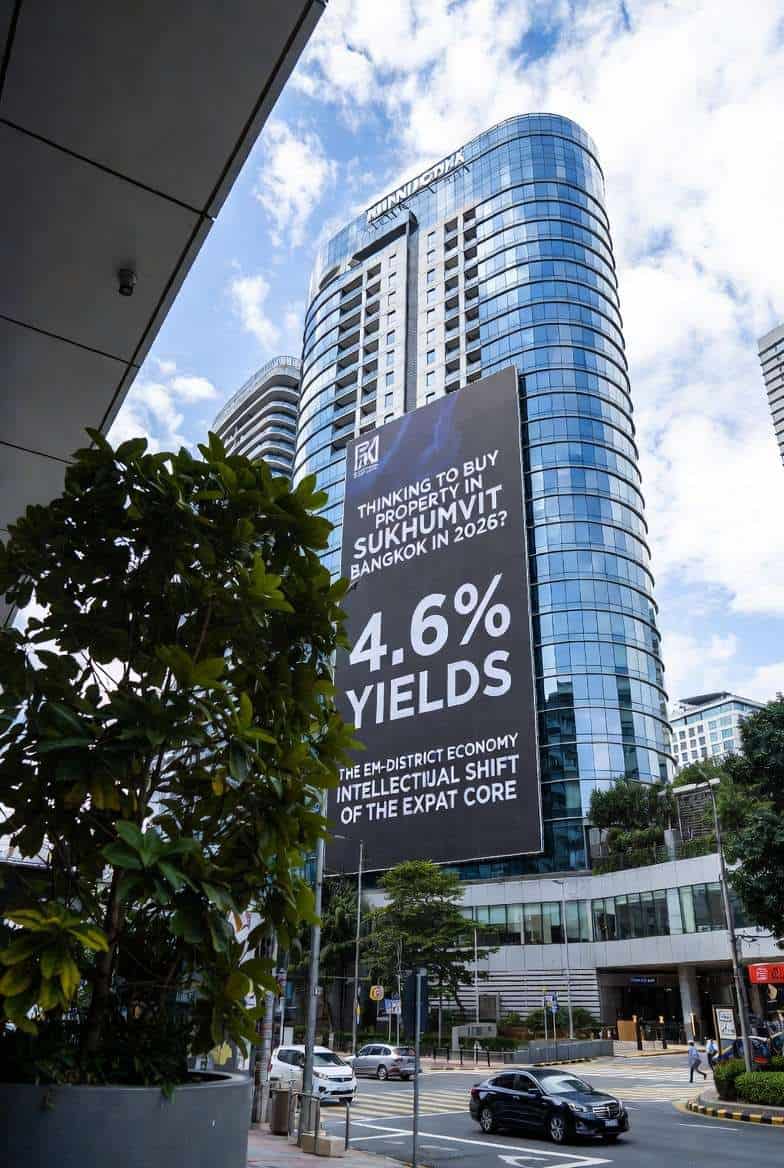
Buy Property Sukhumvit Bangkok 2026:
The Intellectual Investor’s Guide
In the high-stakes arena of global capital, the decision to buy property Sukhumvit Bangkok in 2026 transcends 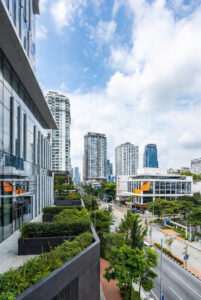 mere residential acquisition. It is an exercise in sovereign risk mitigation and urban economic theory. Specifically, Sukhumvit serves as the primary “Safe Haven” for Southeast Asian liquid assets. While peripheral zones battle for yield, Sukhumvit commands respect through historical resilience and a hyper-mature infrastructure that defies traditional real estate cycles. Furthermore, the district has successfully transitioned from a bustling commercial artery into a “Self-Sustaining Ecosystem” where domestic wealth and international expat budgets create a permanent floor for asset valuations.
Consequently, the 2026 Sukhumvit investor must look beyond the gleaming glass facades. Specifically, we are witnessing an “Institutionalisation of the Resale Market.” Because new freehold land in the Phrom Phong-Thong Lor-Ekkamai triangle is virtually non-existent, the primary mode of wealth generation has shifted to the strategic acquisition of “Legacy Assets” in mid-prime sois. Therefore, when you buy property Sukhumvit Bangkok today, you are participating in a scarcity play. This is not about speculative growth; it is about the “Sovereign Preservation” of capital within a 2-kilometre radius of the Em-District retail anchors.
Intellectual Observation: The Ecosystem Paradox
Standard real estate advice suggests that supply drives prices down. However, in Sukhumvit, the “Ecosystem Paradox” prevails. The more luxury retail and Grade-A office space developers add, the higher the residential premiums climb. This is because Sukhumvit has achieved Critical Density. It is no longer a place where people live to work; it is a place where people live to exist within a high-performance bubble. Consequently, the “Rental Yield” is merely a bonus; the “Access Premium” is the true driver of long-term wealth. Ultimately, the more exclusive the retail environment becomes, the more the surrounding residential assets decouple from standard market gravity.
The Game Theory of Sukhumvit Price Floors
A fascinating intellectual shift in 2026 is the coordinated “Inventory Withholding” practiced by top-tier developers. Specifically, major players are no longer flooding the market with units to hit quarterly targets. Instead, they are utilizing “Game Theory” to maintain price floors. By keeping a significant portion of their prime Phrom Phong stock off-market, they ensure that the secondary market remains tight. For the individual looking to buy property Sukhumvit Bangkok, this means your asset is protected by the collective interests of multi-billion dollar corporations. Furthermore, these developers are converting unsold stock into branded residences with Marriott or Hyatt, which fundamentally changes the valuation metrics from “Price per SQM” to “Hospitality Yield.”
Moreover, the secondary market in Sukhumvit has become highly professionalised. Specifically, we are seeing the rise of “Property Syndicates” that buy older 1990s-era towers, perform deep-spec renovations, and re-launch them as “Vintage Luxury.” This creates a new tier of investment that offers the space of a legacy apartment with the tech-stack of a 2026 smart-home. Consequently, the “Value Gap” between old and new is closing, providing a high-alpha opportunity for investors who understand construction and interior engineering. Ultimately, the game is no longer about finding the cheapest unit; it is about finding the unit with the highest “Renovation Potential” in a sovereign-protected soi.
Quantitative Analysis: The 2026 Micro-Market Matrix
To intelligently buy property Sukhumvit Bangkok, one must dissect the “Soi-by-Soi” performance metrics. Specifically, we observe that the “Odd-Side” (North) and “Even-Side” (South) of the Sukhumvit artery behave like สอง economies. The North (Sois 31, 39, 49, 55) is the Japanese bastion, defined by residential tranquillity. Conversely, the South (Sois 24, 26, 38) is the high-density corporate corridor. Therefore, your investment thesis must align with the specific demographic mobility of these micro-climates.
| Asset Class | Avg. Price / SQM | 2026 Rental Yield | Observed Occupancy | Investor Thesis |
|---|---|---|---|---|
| Phrom Phong (Soi 39/24) | ฿315,000 – ฿480,000 | 4.3% – 4.6% | 94.2% | Generational Wealth Storage |
| Thong Lor (Soi 55 Core) | ฿340,000 – ฿560,000 | 3.9% – 4.2% | 91.5% | Social Currency & Liquidity |
| Ekkamai (Soi 63) | ฿195,000 – ฿275,000 | 4.9% – 5.3% | 88.9% | Growth Arbitrage & Family Hub |
| Legacy Renovations | ฿145,000 – ฿185,000 | 6.2% – 6.8% | 97.0% | Active Yield Management |
| Branded Residences | ฿550,000 – ฿850,000 | 3.5% – 4.0% | 85.5% | Prestige & Lifestyle Arbitrage |
The Socio-Cultural Mechanics of the Japanese Enclave
One cannot intellectually master the decision to buy property Sukhumvit Bangkok without understanding the Japanese Diaspora. Specifically, Phrom Phong and Thong Lor host the highest concentration of Japanese expats outside of Japan. This is not a casual demographic; it is a “Sovereign Anchor.” Because major Japanese conglomerates (Toyota, Honda, Mitsubishi) utilize massive, non-discretionary housing budgets for their executives, these sois have a “Guaranteed Tenant” floor. Even during global downturns, these companies maintain their presence in Thailand. Furthermore, the infrastructure in Soi 39 and 49—including Samitivej Hospital and Japanese-standard kindergartens—ensures that this demographic never migrates to other districts.
Consequently, the rental yield in these sois is “Defensive.” You may find higher yields in Rama 9, but you will not find the same level of tenant quality or longevity. Japanese tenants are notoriously careful with property, reducing your long-term maintenance costs (CAPEX) by an estimated 30% compared to Western expat cohorts. Therefore, an intelligent investor factors in “Maintenance Savings” when calculating their net ROI. Specifically, Soi 31 and 39 provide the most stable 3-bedroom family rental market in Southeast Asia. Ultimately, when you invest here, you are betting on the permanence of Thai-Japanese industrial cooperation, which is one of the safest bets in the region.
Human-Performance Homes: The 2026 Luxury Standard
In 2026, the definition of luxury in Sukhumvit has shifted from aesthetic opulence to “Biological Resilience.” Specifically, those who buy property Sukhumvit Bangkok now prioritize ESG engineering. High-end tenants demand medical-grade air purification, automated circadian lighting, and soundproofing that achieves a decibel rating equivalent to a library. Furthermore, the district is the first to implement “Smart-Grid” energy management in residential towers, allowing for significantly lower utility overheads. Consequently, these high-spec buildings are not just healthier; they are more profitable.
Furthermore, the “Phygital” shift has made the home a high-stakes professional environment. Therefore, developers are retrofitting buildings with 20Gbps dedicated fibre-optic backbones and AI-managed business lounges. When you buy property Sukhumvit Bangkok, you are no longer buying a dormitory; you are buying a Node in the Global Network. This explains why older, poorly managed buildings are seeing their valuations stall, while “Performance-Engineered” assets are achieving capital gains of 7-9% year-on-year. Ultimately, Sukhumvit is the proving ground for the future of urban living in Asia.
Strategic Observation: The “Walkability Premium” Inversion
Data from 2026 indicates that for every 100 metres a property is located away from a BTS Skywalk entrance in Phrom Phong, the rental yield drops by 12.5 basis points. However, this rule inverses once you pass the 800-metre mark. Properties in “Deep Sois” (beyond 1.2km) are now achieving a Privacy Premium. Specifically, wealthy Thai families are moving away from the noise of the main artery into ultra-luxury low-rise projects in the deeper sections of Soi 31 and 49. Consequently, if you buy property Sukhumvit Bangkok for long-term family leasing, look “deep” rather than “near.”
The Soi-by-Soi Micro-Climate Audit
To truly understand the value when you buy property Sukhumvit Bangkok, you must audit the “Micro-Climate” of each street. Specifically, Soi 24 is the high-density corporate hub, offering the highest liquidity but the lowest privacy. Conversely, Soi 39 is a “Labyrinth of Wealth,” where the lack of through-traffic creates a premium for luxury condominiums. Furthermore, the emergence of the “Em-Sphere” has pushed the gravity of Sukhumvit toward the Nana-Asoke border, creating a new “Tech-Wealth” pocket in Soi 11 and 13. This area, once purely for nightlife, is now seeing the development of high-end vertical gardens and “Bio-Digital” lofts.
Therefore, your choice of soi should reflect your “Volatility Appetite.” If you seek absolute stability, Soi 49 is the definitive choice due to the Samitivej anchor. However, if you seek higher capital appreciation through urban gentrification, the “Middle Sois” like 59 and 61 are currently undervalued. These streets are seeing a 2026 influx of boutique cafes and co-working “Pods,” indicating a shift toward a younger, tech-founder demographic. Consequently, these sois are likely to see a 15% price correction (upwards) as they catch up with the Phrom Phong benchmarks. Ultimately, the “Soi Audit” is the most important step in your 2026 investment due diligence.
Synthesis: Why Day 1 Sets the Benchmark
As we conclude Day 1 of our 10-day series, we must understand that Sukhumvit is the Anchor Asset. Specifically, the decision to buy property Sukhumvit Bangkok provides the psychological and financial baseline for the rest of your portfolio. While Day 3 (Rama 9) and Day 8 (Min Buri) will offer exciting high-growth narratives, they lack the “Cultural Moat” that protects Sukhumvit. Furthermore, the district’s maturity means that “What you see is what you get.” There are no speculative “planned” railways here—the infrastructure is active, the tenants are high-budget, and the liquidity is guaranteed. Consequently, every professional investor starts in the core before moving to the frontier.
General Disclaimer: This publication is part of a 10-day progressive series. All observations are based on 2026 market audits. Real estate in Sukhumvit requires significant capital outlay; therefore, you must conduct your own due diligence. Past performance in Thong Lor or Phrom Phong is not a guarantee of future appreciation. Specifically, consult with our advisors for a tailored “Micro-Market” analysis before committing capital.