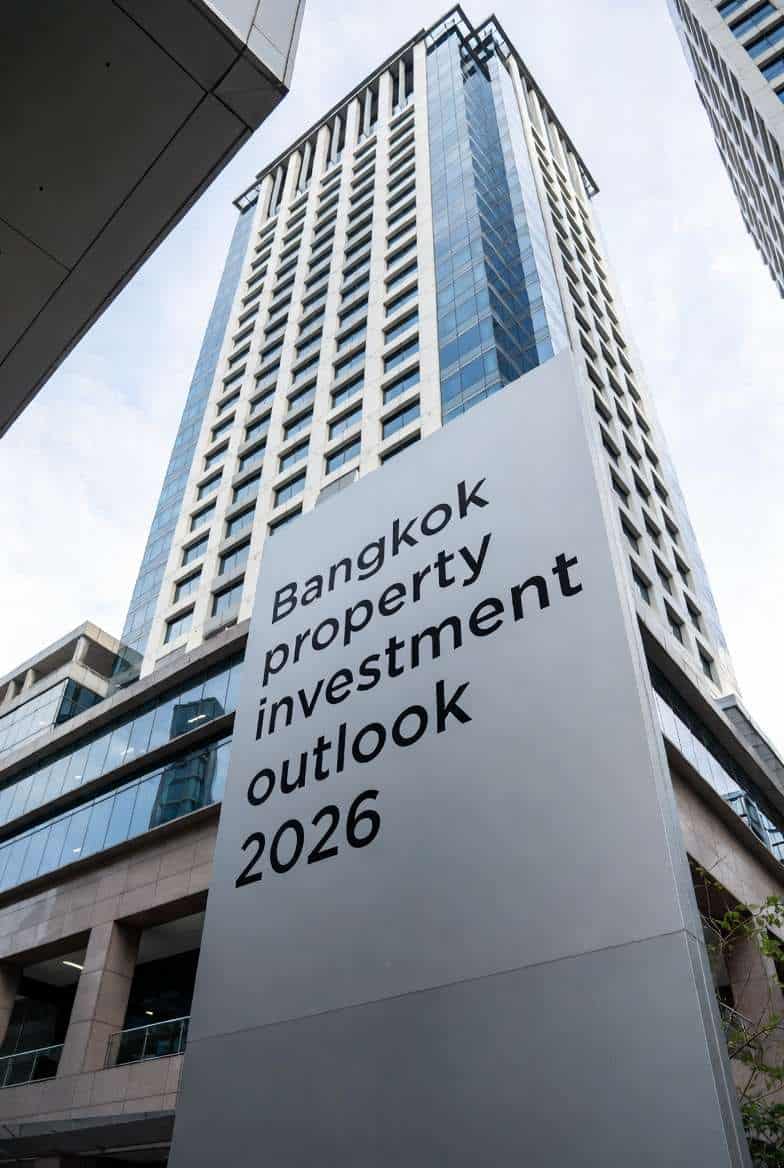
Bangkok Property Investment Outlook 2026:
The Strategic Finale
As we conclude our 10-day progressive series, the Bangkok property investment outlook 2026 has moved from a collection of geographic observations into a cohesive systemic framework. Specifically, the journey from the “Established Core” of Sukhumvit (Day 1) to the “Economic Anchor” of Samut Prakan (Day 9) has demonstrated that Bangkok is no longer a mono-centric city. It is a polycentric metropolitan network defined by transit-interchanges and logistical nodes. Furthermore, the 2026 investor must understand that capital preservation and high-alpha growth are now found in different corners of the same rail network. Consequently, the final step in our narrative is the synthesis of these districts into a “Balanced Portfolio” that mitigates systemic risk while capturing the velocity of Thailand’s digital and industrial transformation. Ultimately, this outlook provides the roadmap for navigating a maturing market that rewards intellectual depth over speculative hype.
Intellectual Framework: The Yield-to-Infrastructure Maturity (YIM) Model
Traditional property analysis treats all yields as equal. However, in the Bangkok property investment outlook 2026, the “YIM Model” prevails. This model suggests that the **Quality of a Yield** is determined by the stage of its supporting infrastructure. Specifically, a 6% yield in a mature hub like Sathorn (Day 2) is “Lower Risk” than a 7.5% yield in an emerging gateway like Min Buri (Day 8). Why? Because the mature hub possesses Institutional Depth. Conversely, the emerging gateway offers Capital Velocity. Consequently, the 2026 outlook is driven by the “Diversification Pivot.” An intelligent investor splits their capital between “Core Preservation Assets” and “Frontier Yield Engines.” This is the only way to ensure long-term resilience in a high-interest rate global environment. Therefore, we view the 2026 portfolio as a “Hybrid Vehicle” designed for both stability and speed.
Deep Dive: The 2026 Portfolio Diversification Matrix
Investors must now apply a **Tiered Allocation Strategy** to their Bangkok holdings. Specifically, we categorise the 10 days of this series into three distinct risk-reward buckets: **The Anchors, The Accelerators, and The Frontiers**. Understanding how these interact is the key to the Bangkok property investment outlook 2026. While Day 1 Sukhumvit provides the prestige, Day 4 Bang Na provides the cash flow. Therefore, your “Synthesis” must reflect your personal liquidity requirements and time-horizon. Each tier serves a specific purpose in the wealth-generation cycle.
Specifically, these are the assets in **Sukhumvit, Sathorn, and Silom** (Days 1 & 2). These provide Generational Wealth Storage. Because land in these districts is finite, the appreciation is non-cyclical. Investors here focus on “Legacy Assets” and “Branded Residences.” Furthermore, the presence of Tier-1 hospitals and schools ensures near-zero vacancy. Ultimately, the Anchors protect your capital during global economic corrections. Consequently, these should represent at least 40% of a 2026 conservative portfolio.
Conversely, these are the assets in **Rama 9, Ratchada, and On Nut** (Days 3 & 4). These provide Professional Cash Flow. Specifically, the digital and tech-workers of 2026 drive the demand here. Because these areas offer higher yields (5.5%+) and lower entry costs, they accelerate your portfolio’s liquidity. Furthermore, the completion of the MRT Orange Line provides a secondary appreciation catalyst. Ultimately, the Accelerators ensure that your portfolio generates the income required to fund further acquisitions. Therefore, these represent the “Growth Engine” of your investment strategy.
| Strategic Tier | Associated Districts | Target Yield (2026) | 5yr Appreciation Forecast | Recommended Weighting |
|---|---|---|---|---|
| Sovereign Preservation | Sukhumvit / Sathorn | 4.2% – 4.6% | +15% – 20% | 40% – 50% |
| Digital Cash Flow | Rama 9 / Ratchada / On Nut | 5.4% – 5.9% | +25% – 35% | 30% – 40% |
| Infrastructure Frontiers | Min Buri / Lat Krabang / Samut Prakan | 6.5% – 7.5% | +40% – 55% | 10% – 20% |
| ESG / Wellness Hubs | Wang Thonglang / Rat Burana | 5.0% – 5.5% | +30% – 45% | Opportunistic |
Risk Management in 2026: The Three Pillars
One cannot intellectualise the Bangkok property investment outlook 2026 without addressing systemic risk. Specifically, we identify three primary risk pillars for the outer Bangkok corridors: **Infrastructure Completion Risk, Demographic Oversupply, and Environmental Resilience**. Because the “Outer” rings rely heavily on rail lines, any delay in secondary phases (such as the MRT Brown Line) can stall capital growth. Therefore, an intelligent investor prioritises “Active Lines” over “Planned Lines.” Furthermore, we see a “Middle-Market Trap” in districts with excessive vertical density but limited employment anchors. Consequently, your due diligence must include an audit of the “Commercial-to-Residential Ratio” in the immediate station vicinity.
Moreover, **Environmental Resilience** is now a non-discretionary factor. Specifically, the “Bio-Digital” shift in 2026 has made flood-mitigation and air-filtration the primary metrics for resale value. As Bangkok adapts to climate shifts, properties that integrate “Sponge City” engineering and “Clean-Air Guarantees” are outperforming standard towers. Ultimately, the 2026 investor treats their home as a “Biological Asset.” Consequently, the “ESG Premium” is no longer a marketing buzzword; it is a financial necessity. Therefore, we recommend avoiding “Legacy Cheap” units that cannot be retrofitted for 2026 wellness standards. Ultimately, the cheapest asset often carries the highest “Obsolescence Cost.”
Strategic Tip: The “Diversification Pivot”
In 2026, data suggests that investors who hold a single property in one district are 3x more likely to face cash-flow volatility than those who “Split the Interchange.” Specifically, if you have ฿10M, do not buy one luxury unit in Thong Lor. Instead, buy a ฿6.5M unit in Phrom Phong (Anchor) and a ฿3.5M unit in Min Buri (Frontier). This strategy provides you with the Preservation of the Core and the Velocity of the Rail Hub. Consequently, your “Portfolio-Wide Yield” will average 5.4%, but your capital risk is diversified across two distinct economic engines. Ultimately, the 2026 outlook rewards “Strategic Spreading” over “Geographic Concentration.”
Human-Performance Homes: The Long-Term Vision
In 2026, the Bangkok property investment outlook is dominated by the **Wellness Economy**. Specifically, the emergence of “Health-Tech Districts” like Wang Thonglang has redefined what a residential asset must provide. High-budget tenants are no longer looking for gyms; they are looking for “Longevity Suites.” This includes automated circadian lighting to manage stress, private medical-grade air scrubbers, and “Greywater Recycling” for private vertical forests. Furthermore, these features reduce CAM (Common Area Maintenance) costs over a 15-year horizon. Consequently, these “High-Performance” buildings are the only assets that will remain liquid in the 2030s. Ultimately, the 2026 tenant views their home as a “Professional Recovery Hub.” Therefore, the strategy for Day 10 is to ensure your portfolio is “Future-Ready” for the biological demands of the next decade.
Final Synthesis: Navigating the 2026–2035 Cycle
As we conclude this 10-day masterclass, we must understand that the Bangkok property investment outlook 2026 is one of **Selective Optimism**. Specifically, the era of “Buying the City” is over; we are now in the era of “Buying the Node.” Whether you are looking at the sovereign stability of Sukhumvit or the logistical velocity of Lat Krabang, your success depends on your ability to synthesise transit, technology, and legal clarity. Furthermore, the district-level shifts we have explored demonstrate that Bangkok is maturing into a world-class megacity that rivals Singapore and Tokyo in infrastructure depth. Consequently, the 2026 investor is no longer a spectator; they are a strategic participant in the country’s primary economic engine. Ultimately, the future of Bangkok is multi-nodal, wellness-driven, and hyper-connected. This is the synthesis of wealth in the new Thailand.
General Disclaimer: This publication concludes our 10-day progressive series. All observations are based on March 2026 market audits. Real estate investment involves systemic, legislative, and environmental risks. Therefore, you must conduct your own due diligence and consult with qualified legal and tax professionals before committing capital. Past performance is not a guarantee of future outcomes. All forecasts are based on current 2026 infrastructure maturity levels.