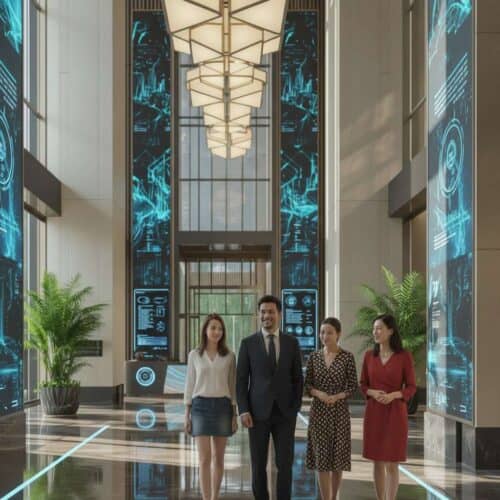
As we move through March 2026, the gravitational centre of Thai real estate is shifting. For decades, “prime” meant a ten-block radius in Central Bangkok. However, an observational rift has opened. At Kan Homes, we are tracking a massive migration of institutional capital toward the Chonburi Smart City investment 2026 corridor—a region now colloquially known as “Bangkok 2.”
This is not merely suburban expansion; it is the birth of a multi-billion dollar “Aerotropolis.” As the Eastern Economic Corridor (EEC) matures, the demand for purpose-built, high-tech urban environments is outstripping the supply of traditional Bangkok high-rises. Here is our deep-dive analysis into why March 2026 is the pivotal moment for this region.
1. The ‘Bangkok 2’ Phenomenon: Beyond the CBD
The primary driver of Chonburi Smart City investment 2026 is the “De-centralisation” of wealth. Bangkok’s historic core is facing an infrastructure ceiling. In contrast, the Chonburi Smart City is built on a “Greenfield” site. This means the infrastructure—including 6G telecommunications, automated waste management, and renewable micro-grids—is integrated into the soil before the first brick is laid.
Consequently, we are seeing a “Flight to Quality.” Major multi-national corporations are relocating their regional headquarters to the EEC to benefit from tax incentives. Naturally, the executive residential market is following. This is creating a high-yield rental vacuum that savvy investors are beginning to fill this quarter.
2. Integrated Sustainability: The 2026 Requirement
In March 2026, “Green” is no longer a marketing buzzword; it is a fiscal requirement. Modern tenants, particularly from Europe and North America, are demanding ESG-compliant housing. The Chonburi Smart City projects are the first in Thailand to offer “District Cooling” and solar-integrated facades as standard.
Predictive data suggests that these “Sustainability-First” buildings will maintain a 15% higher resale value over the next decade compared to uncertified builds in Bangkok. Therefore, an investment here is a hedge against the rising energy costs and climate-risk sensitivities that are starting to impact older urban assets.
3. The Connectivity Catalyst: High-Speed Rail Link
The observational “tipping point” for 2026 has been the completion of the High-Speed Rail link connecting Don Mueang, Suvarnabhumi, and U-Tapao airports. This has effectively deleted the distance between the capital and the coast. A commute from Chonburi to Central Bangkok is now faster than a cross-town journey from Thong Lo to Bang Na during rush hour.
This “Temporal Compression” is driving a surge in property valuations. We predict that by the end of 2026, the price-per-square-metre in prime Chonburi Smart City sectors will begin to achieve parity with secondary Bangkok districts, offering significant early-entry capital appreciation for March buyers.
4. Predictive Risk: Navigating the PPP Model
Educational insight for our investors: The Chonburi Smart City operates on a Public-Private Partnership (PPP) model. This provides a layer of sovereign security rarely seen in retail real estate. Because the Thai government is a stakeholder in the infrastructure’s success, the risk of “stalled” projects is significantly lower than in purely private developments. However, entry remains competitive, and “Selective Asset Acquisition” is vital to ensure long-term liquidity.
Position Your Portfolio for the EEC Surge
The map of Thailand is being redrawn in 2026. “Structural Shifts” before they become mainstream news. Are you ready to look beyond the BTS line?