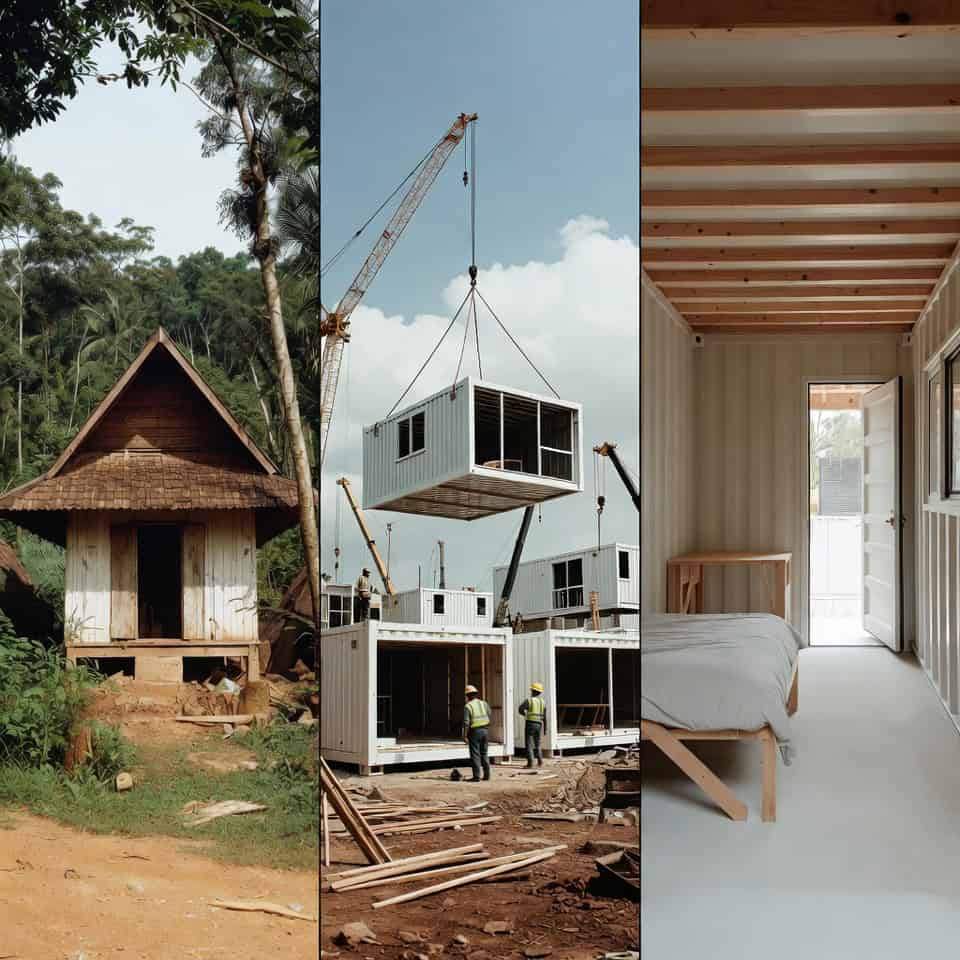
🏡 SERIES: Part 2 of 5 — Tiny Living, Big Paradise
Tiny Home vs. Prefab: What’s the Real Difference?

If you jumped into Part 1 of our series feeling inspired but a little confused about terminology — welcome to the club. “Tiny home,” “prefab,” “modular,” “container home” — these terms get thrown around like they’re interchangeable, but they’re not. And picking the wrong one for your goals can mean the difference between a smooth, joyful build and a very expensive headache.
So let’s clear the fog. By the end of this post, you’ll know exactly which category fits your lifestyle, budget, and land — before you spend a single baht.
🔨 First, the Definitions
Let’s start with plain-English definitions, Thailand-style:
| Term | What It Actually Means |
|---|---|
| Tiny Home | Small-footprint home (20–60 sqm), can be built via any construction method — traditional, modular, or container |
| Prefab (Prefabricated) | Home components built off-site in a factory, then transported and assembled on your land |
| Modular | A type of prefab — entire finished “modules” or rooms are built and joined together on-site |
| Container Home | Repurposed or purpose-built shipping containers converted into livable space |
| Traditional Build | Built entirely on-site, brick by brick, board by board, the old-fashioned way |
So here’s the key insight: “tiny” describes the size, “prefab” describes the construction method. You can absolutely have a tiny home that’s NOT prefab, and a prefab home that’s not tiny at all. But in Thailand, the two trends have merged beautifully — because prefab construction is often the fastest, cheapest, and most climate-smart way to build small.
⚖️ The Head-to-Head Comparison
Here’s how the two most popular routes — traditional tiny builds and prefab/modular builds — stack up against each other:
| Factor | Traditional Tiny Build | Prefab / Modular |
|---|---|---|
| Build Time | 4–8 months | 6–12 weeks |
| Cost Predictability | Moderate — weather delays, labor costs can shift | High — factory pricing is usually fixed upfront |
| Customization | Fully custom, unlimited design freedom | Semi-custom — based on set floor plans with finish options |
| Site Access Needs | Flexible — works on tricky/remote plots | Needs road/crane access for delivery |
| Quality Control | Depends heavily on the local crew | Factory conditions = consistent quality |
| Best For | Buyers wanting a fully bespoke, architect-led home | Buyers wanting speed, budget certainty & simplicity |
🏗️ A Closer Look at Materials
Thailand’s tropical climate — heavy rain, intense sun, high humidity — makes material choice more than just an aesthetic decision. It genuinely affects how long your home lasts and how comfortable it feels day to day.
- Teak & local hardwoods: Beautiful, durable, and naturally resistant to insects — the traditional favorite, though pricier
- Steel-frame prefab: Fast to assemble, resistant to termites, but requires good insulation to manage heat
- Shipping containers: Extremely durable and often more affordable, but need proper insulation and ventilation upgrades to stay cool
- Composite/engineered materials: Increasingly popular in modern prefab kits — low maintenance, weather-resistant, budget-friendly
🧠 So Which One Is Right for You?
Here’s the honest realtor take: there’s no universally “better” option — only what’s better for you.
💡 Choose Traditional Build if: you have a specific architectural vision, you’re not in a rush, and you have a trusted local contractor relationship.
💡 Choose Prefab/Modular if: you want to move in fast, you value cost certainty, and you’re comfortable with a curated (rather than fully custom) design.
🔮 Coming Up Next
Now that you know your construction options, the next big question is: where in Thailand should you actually build? In Part 3, we’re comparing the top regions — Chiang Mai, Koh Samui, Phuket, Hua Hin, and Pai — so you can match your lifestyle to the right location.
👉 Still deciding between build types? The team at KAN Homes can walk you through options based on your land and goals.
Disclaimer: This article is provided for general informational and educational purposes only and does not constitute legal, financial, tax, or professional real estate advice. Property laws, ownership rules, costs, and market conditions in Thailand are subject to change and may vary by region, developer, and individual circumstances. Readers should conduct their own independent research and consult with qualified local legal, financial, and real estate professionals before making any property-related decisions. KAN Homes makes no warranties or guarantees regarding the accuracy, completeness, or timeliness of the information presented in this post.